Thursday, April 29, 2010

What is the value of faith?

The things I love the most about our faith are the things I don’t know. Mysteries the substance for which I hunger and feed upon. This is why the Rosary touches me in such a profound way. Only recently, while drudging my way through some novenas (yes, drudging) have I started to truly realize the value of its mysteries.

Besides the glorious, sorrowful, joyful, & luminous mysteries, there are also three little Aves at the beginning of the Rosary where (I’m told) we are to pray for the virtues of faith, hope, and love. These virtues are mysteries in themselves.


When praying these Aves, I would often have in mind 1 Corinthians 13:

At present we see indistinctly, as in a mirror, but then face to face. At present I know partially, then I shall know fully, as I am fully known. So faith, hope, love remain, these three; but the greatest of these is love.

Because love is the greatest, I used to pray more fervently for that virtue than for the other two. They didn’t seem as important. In fact, I sometimes wondered how faith and hope were even useful.


When praying my novena, which was for the faithless, I started thinking about faith in a different light. I realized that they were hopeless because they were faithless. They couldn’t have hope because they didn’t believe in it.

What do we have hope in? We hope for the greatest of these, the greatest desire of our hearts – Love.


So we must have faith in hope, and hope in love. They lead to each other, and they can't be separated. At present we know only partially, but someday we shall know fully!

Monday, March 29, 2010

The Shores of Valinor

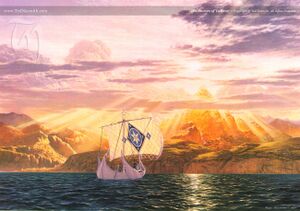
The description for this blog is "these are the things that intrigue and inspire me." I suppose it's obvious that I'm mostly inspired by books, but there are an endless amount of things that catch my interest. One thing that's been affecting me lately is this painting by Ted Nasmith:


It's been my desktop image for a week, and I keep noticing more things I like about it. Aesthetically, I love the width of the landscape, the majesty of the mountains & clouds, and especially the depth & lustre of the sea. But more than that, I love how the light at the top of the mountain is bright, but hidden. You can see that there must be a great canyon beyond the brink, but that too is hidden. The scene is beautiful, but it heightens your desire to see more. I also love the subtle details like the waterfall on the mountainside and the birds flying between the ship and the shoreline. If you look closely, you can see figures on the ship, clasping each other with their arms outstretched toward the light.

The title of this piece is The Shores of Valinor. It is inspired by The Silmarillion (so I suppose it's literary as well as artistic...of course it would still have to do with books...) Valinor is, in some ways, the paradise of Middle-earth. What the painting signifies to me is the heavenly fulfillment of our desires for greatness & beauty. Heaven will be everything our hearts have ever longed for because it will be complete unity with God. When I was little, I remember not wanting to go to heaven because I didn't want to leave all the delights of earth. But what I didn't realize was that heaven is all the delights of earth multiplied by infinity.

The couple on the ship have made a journey - a long, difficult journey - and have depended on each other to complete it. They have two arms reached out in rapture and two arms grasping each other. To me it's a picture of true friendship. The aim of true friends is to help each other reach Heaven - union with God. And that's what a marriage of two souls should always be.

Those are just some of the things that have been going through my head as I've logged onto my computer every day. ;) It's good to have a constant reminder to set my thoughts on worlds far off / where we only cry from joy.
Set your sails upon the mighty winds of May
Set your sails upon the hope of June
Set your sails upon the air of warm July
Set your course for Heaven's shore!
- Future of Forestry
[Music is another thing that inspires me a great deal; I should write about it more often!]

Wednesday, March 24, 2010

Our Vocation is Today

People seem to focus so much on the future. Our vision is naturally horizontal -- looking at the things in front of us (or behind). Some of us fruitlessly dwell on the past, and others (like myself) have the tendency to dwell in our imaginings of the future. What I wish I could do is shift my eyes to a vertical perspective, one that moves along the x-axis of time, but is always fixed on the y-intercept of the present.

What I mean is, if we could look upward, focused on God and not on our own fates, our fates won't get messed up by our tainted, twisted selves. We don't live for the future; we live for the infinite God. Our lives shouldn't be directed toward our own pursuits; they should always be in pursuit of Him. I've come to realize that it doesn't matter much what happens to me as long as I am in union with God when it happens.

I came across this passage when I was re-reading The Screwtape Letters for my previous post, and I think it explains the "present" concept brilliantly:
The humans live in time, but [God] destines them to eternity. He therefore, I believe, wants them to attend chiefly to two things, to eternity itself and to that point of time which they call the Present. For the Present is the point at which time touches eternity. Of the present moment, and of it only, humans have an experience analogous to the experience which [God] has of reality as a whole; in it alone freedom and actuality are offered them.
Recently, I've been faced with many "coming of age" decisions, and to be honest, I've struggled a lot with entrusting them to God. But He has given me a great confidence because, even when I feel I don't know what to do with my life, I know that my life should belong to Him no matter what I do. I try to embrace that knowledge because it gives me purpose in the present.
So do not worry and say, 'What are we to eat?' or 'What are we to drink?' or 'What are we to wear?' All these things the pagans seek. Your Heavenly Father knows that you need them all. But seek ye first the kingdom (of God) and his righteousness, and all these things will be given to you besides.
On a bigger scale, for the last 5 years I have wondered and prayed about my "vocation," whether I should serve God within a family, or consecrate my whole self as my patron St. Cecilia did. I have a deep attraction to both lives, and I have come to realize it is because they both have the same call - to live a life of love, just as Christ loved us and gave Himself up as a sacrifice for us. All lives have this same call, and when we answer it, we are fulfilled in the deepest part of our souls.
Our vocation is LOVE, and we are called to it NOW.

Wednesday, March 3, 2010

Significant Books, Part VII

The rude, uncomfortable human self-portrait presented in The Screwtape Letters puts me to shame every time I read it. But it's the sort of healthy shame that I need provoked with - the fact that the Creator put in us dignity, purpose and love, and our sin and selfishness are perversions of that.

Lewis shows how "devils" love perversion, confusion, and vacant minds. Haziness and tepidity delight them. They love it when we make God little in our minds, defining our spiritual lives by emotions or social perceptions. But despite their diabolical power, they are entirely crippled by virtue, and especially sincere humility - what Lewis called the "real nakedness of the soul in prayer."
...if he ever consciously directs his prayers "Not to what I think thou art, but to what thou knowest thyself to be," our situation is, for the moment, desperate. Once all his thoughts and images have been flung aside or, if retained, retained with full recognition of their subjective nature, and the man trusts himself to the completely real, external, invisible Presence, there with him in the room and never knowable by him as he is known by it -- why, then it is that the incalculable may occur.
We so often forget that we are serving a fathomless, infinite, incomprehensible Being. If only we would worship Him with awe! The more we fear the Lord, the more we're aware of the stupidity of our sins, but the amazing thing is that the more we stand in awe of our Creator, the more we understand who we are, because we're made in His beautiful image.
Remember, always, that He really likes the little vermin, and sets an absurd amount of value on the distinctness of every one of them. When He talks of their losing their selves, He means only abandoning the clamour of self-will; once they have done that, He really gives them back all their personality, and boasts (I am afraid, sincerely) that when they are wholly His they will be more themselves than ever.
There are so many things addressed in this little book, but one that strikes me especially hard, especially during the season of Lent, is the importance of submitting the will to God. No matter how much I think or talk about loving Him, it's all for nothing if I don't actually obey Him.
The great thing is to prevent his doing anything. As long as he does not convert it into action, it does not matter how much he thinks about this new repentance. Let the little brute wallow in it. Let him, if he has any bent that way, write a book about it; that is often an excellent way of sterilising the seeds which an enemy plants in a human soul. Let him do anything but act. No amount of piety in his imagination will harm us if we can keep it out of his will.
The Screwtape Letters makes the list of my significant books because it opened my eyes to the constant raging of spiritual warfare and heightened my perception of God, not as a someone we define, but as someone who defines us.

Sunday, February 21, 2010

Man Does Not Live by Bread Alone

In the weeks before Ash Wednesday, there were many moments when I got drawn into some kind of indulgence (food, internet, music, &c), and had the burning thought, "I need Lent!" It surprised me how much my soul longed for fasting.

There's a yearning again A thirst for discipline A hunger for things that are deeper (Cry in My Heart - Starfield)
When I depend too much on material things, my orientation turns back into myself, my image, my desires. The selfish soul is a miserable soul. Fasting is so powerful because it purges out the selfishness and turns the soul's orientation outside of itself--up toward God, and around toward men. I love that fasting is such a physical discipline. As corporeal humans, we need that. We can't forget that Christ is human as well, and He has physically sacrificed Himself for us in every way. Can't we be a little hungry for Him? Can't we endure a little silence for Him? A passage from St. Augustine's Confessions helped me think of it this way: if we can't have the physical discipline to get out of our comfortable beds in the morning, how can we have the spiritual discipline to get out of our comfortable sins? Getting up early is a denial of self-pleasure, but once you do it you really begin to live. Getting out of our sins is a denial of our flesh, but we can't truly begin to live until we wake up. Man does not live by bread alone, but by every word that comes forth from the mouth of God. The discipline of Lent helps us to lose our dependence on material things and become more dependent on the Word of God. This scripture has always meant a lot to me, but as a Catholic it totally blows me away, and here's why: Christ is the Word spoken by the Father, and He is the Bread that gives us eternal life. He is our literal nourishment. During Lent, my goal is to lose some of my attachments to worldly comforts and start really living on Christ.

Sunday, February 14, 2010

What We're Created For

Our bodies are designed to eat. Our mouths, teeth, salivary glands, tongue, esophagus, stomach...they all serve the purpose of nourishing us. When we don't eat, our bodies clearly communicate to us that something's wrong. They ache from pain and they yearn for food.

People everywhere are aching and yearning in pain from a different kind of malnourishment. They aren't doing what they are designed for, and they die.

Man has always asked what his purpose is. The question has existed for as long as man has existed. Why are we here?! What are we for, if anything? It's clear that we're designed for something larger than this life. Why else would we ache and yearn so much? We have so much desire inside of us that is almost always unsatisfied. Why? What do we desire?

We find comfort in relationships, in feeling wanted, and in feeling needed. We desire companionship, and most of all we NEED love. We find purpose and joy when we have love. It's the selfish, the lonely, and the closed souls who are miserable. To love is to have a healthy soul. To go without love is against our design, just like going without food goes against our design; it will make us sick and eventually kill us.

It's kind of like a love-shaped hole, but I wouldn't even call it a hole. I'd call it an existence. We're nothing without it.

We are nothing without the Creator. The Creator designed us in His image. Did you ever wonder what that means? It probably doesn't mean that he made us look physically like Him. I think that when He designed us, He designed us to love. That's His mark on us, because HE IS LOVE. And He didn't just put it in our souls, He did put it on our bodies as well. Sex is supposed to be a physical manifestation of love. That's why, when it's misused, it causes us so much pain.

If there is a heaven, then it must be made of love.

Friday, February 5, 2010

Significant Books, Part VI

[Again, this series of Significant Books isn't necessarily my favorite books, but rather, books that have influenced me in my life or shaped my philosophy in some significant way.]

Nearly 6 years ago, I was sitting in my Baptist Sunday School class as the teacher was handing out blank cards to everyone. "We want to make this class interesting and relevant to you," he said, "so write down anything you might want to learn more about, and we'll try to answer your questions in the coming classes." I wrote down the weightiest question on mind--"What is the difference between Catholics & Protestants, and why are Protestants right?"

At that point, Catholicism was a large question mark in my mind--grown larger from my parents obvious interest in it. I knew it was controversial, but I had never heard a clear explanation as to what it was or why it was supposedly teaching a "different gospel."

I was probably more attentive during our next Sunday School class than I had ever been before. Afterward, I was unconvinced. I knew the arguments didn't hold water, and I was dying to know how to answer them. Catholicism and Fundamentalism by Karl Keating was the first book Dad gave me to help answer my many questions. I ate this thing like candy. It solidified all that I knew was right, but couldn't explain till that point. It pointed out the Scriptures and gave a true representation of what the Church taught. For the first year of our conversion, as I searched the Scriptures with new openness, I used this book as a tool to understand what the Church taught about it and why.

This book really didn't change a thing about what I believed. I knew that I was a Christian and I wanted to follow God. But the Church gave me a fuller and deeper understanding of Christianity and the tools to follow God in even more radical ways. It made my Christian faith more of a reality.

The first half of this book exposes the holes in prominent anti-Catholic literature. The second half answers the common accusations against the Church. As I said, it was the first book of its kind I had ever read. It opened the door to MANY other books, and "Catholic apologetics" became one of my biggest passions. Catholicism and Fundamentalism will always be significant to me because it was a gateway for such a huge change in my life.

I am still very passionate about defending and building up the Church; in fact, it is one of the main reasons why I've gotten involved in blogging. After 5 years of being Catholic, I've received so many spiritual (and intellectual) gifts of God through the Church, and few things give me more joy than sharing that with others.

But really, the biggest thing that this book spurred on was not a desire to teach or explain Catholicism to others (though that goes along with it). The most amazing thing I've learned is that I can never stop learning! God is infinite, so we can go on learning about Him and growing closer to Him forever. I want to keep a hunger for the truth and an eagerness to share it.