Showing posts with label Literature. Show all posts

Friday, March 6, 2015

Future Societies and Servitude


There's always something chilling about a futuristic novel, even when its motif is heat and fire. Ray Bradbury's Fahrenheit 451 takes readers to a progressed society where houses are fireproof, and firemen protect the city by burning the threats to its happiness and security. What are those threats? Ideas. Books. Each one has something in it that offends someone else - makes them unhappy. The authors disagree amongst themselves and therefore hazard peace.
Ask yourself, What do we want in this country, above all? People want to be happy, isn't that right? Haven't you heard it all your life? I want to be happy, people say. Well, aren't they? Don't we keep them moving, don't we give them fun? That's all we live for, isn't it? For pleasure, for titillation? And you must admit our culture provides plenty of these.
The people live leisurely with giant TV walls and constant surround sound. Worries hardly exist. Each house is well-stocked with sleeping pills. If children are born, they're placed in school as infants. No one argues about politics because running the country is someone else's job to worry about. No one has to undergo the unpleasant act of thinking.

We must all be alike...Every man the image of every other. Then, all are happy, for there are no mountains to make them cower, to judge themselves against. So, a book is a loaded gun in the house next door. Burn it. Take the shot from the weapon. Breach man’s mind. Who knows who might be the target of the well-read man. Me? I won’t stomach them for a minute. And so when houses were finally fireproofed completely all over the world…there was no longer need of firemen for the old purposes. They were given the new job as custodians of our peace of mind, the focus of our understandable and rightful dread of being inferior.
Aldous Huxley's Brave New World is an even eerier utopia. The government has no need to burn books; it conditions the citizen's subconscious to hate them. A human reproduction factory spits out clone groups, and with scientifically precise methods, designs their bodies and brains to do certain tasks. And not just to do those tasks, but activate the most possible pleasure sensors by doing it. So no military force is required to keep vast populations in slavery; they willingly submit. As Huxley wrote:

“A really efficient totalitarian state would be one in which the all-powerful executive of political bosses and their army of managers control a population of slaves who do not have to be coerced, because they love their servitude.”

These clones also have every sensual pleasure available to them. The "Feelies" are movie theaters that bring all 5 senses into an alternate reality. "Soma" is their perfect drug, whisking them into a chemical alternate reality rather than a technological one. And with all these diversions, the citizens are "happy."

In both of these novels, freedom is exchanged for comfort. Individual thought for security. Life for "happiness." In the first part of the 20th century, both Bradbury and Huxley saw these exchanges begin to occur. In 2015, they are frighteningly evident in the new moral code of society where what "feels good" is considered morally good. In fact, I know several friends who would probably not find these futuristic societies offensive at all, but see them as hopeful ideals where people can finally do what they please without experiencing pain.

Then why were they intended as horror stories? I think it's because we understand that pleasure is not an end in itself, but a means to a greater end. That a life of merely endless entertainment, sex and drugs is somehow beneath us. At the end of Fahrenheit 451, Guy Montag is aptly dubbed "The Book of Ecclesiastes," which opens with the refrain "Vanity of vanities! All is vanity!" John Savage, at the end of Brave New World, tries to convince the crowd of the vapidness of their indulgence. But then what is the end of pleasure if not to fulfill us?

For the Christian, pleasure is a glimpse of Heaven, something to remind us of the coming joy that truly will fulfill. A Christian enjoys pleasure more than anyone else, knowing its meaning, and he can go without it with more joy, knowing that it's not a necessity or end. Lent is a great example of this. From the outside, fasting seems like bondage, but in reality the fasting keeps us free of the bondage Bradbury and Huxley describe. We don't need the constant outside stimulation because we have a more lasting food. So how will our society avoid Bradbury and Huxley's dire forecast?
Jesus said to them, "I am the bread of life. He who comes to me shall not hunger, and he who believes in me shall never thirst."

Monday, January 26, 2015

Trifles

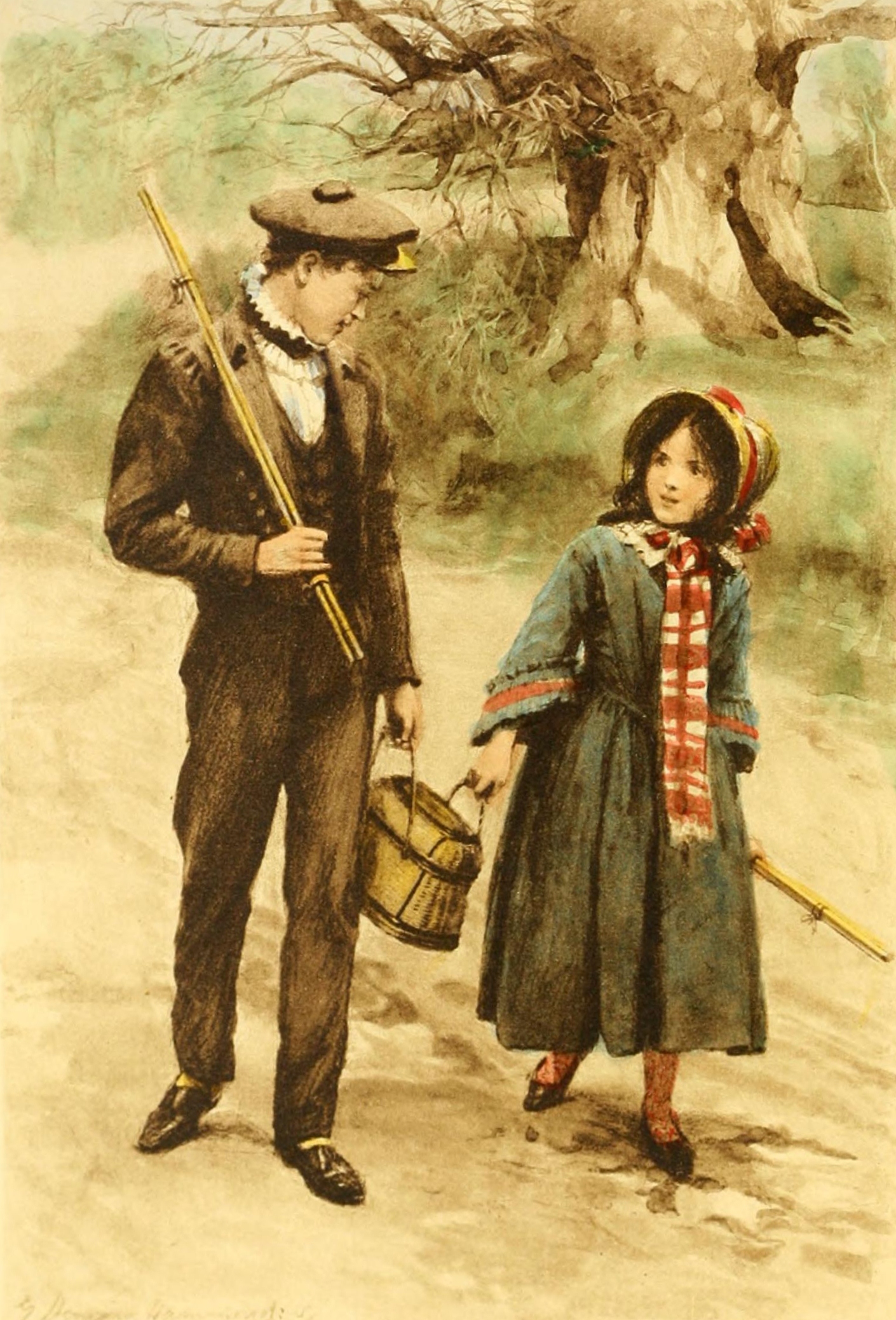
   I recently read the George Eliot novel The Mill on the Floss which tells the story of young Maggie Tulliver, a spirited, impulsive girl who idolizes her older brother Tom more than anyone in the world. As she gets into her many scrapes, the grown-ups complain of her unruliness and, try as they might, fail to keep her under control. Tom grows older, becoming more proud and serious, and joins the adults in their scolding and rebukes.
http://upload.wikimedia.org/wikipedia/commons/1/12/Tom_and_Maggie.jpg
   Little do they know the inner tumult Maggie experiences each time she falls out of grace with her brother.  They don't see how desperately she wants to be good so she can please him, or how a single harsh word from Tom can make her feel like the the sun has gone out in her world.

   The book describes the intensity with which she feels all these things, but Mrs. Tulliver and the disapproving aunts write off Maggie's despairs as trifles. And on the surface, they are trifling: a cold glance from Tom, a forgotten token, a spoiled afternoon plan. They're almost nothing compared to the troubles of the grown-ups. 

   But just because her troubles are smaller doesn't mean they're any less painful. Maggie is smaller, and all her woes are proportionate to herself. It only takes a little water to fill a short glass, but nonetheless it is still full. 

   In self-reflection, I was a bit rattled when I recognized Mrs. Tulliver in my own life. When children come to me with their troubles, I'm guilty of belittling their experiences: "That's not so bad compared to ______," I do want to help them get a right perspective of the world, but I also realize that I need to acknowledge those "trifles" as seriously as they do.  
Tom & Maggie from The Mill on the Floss


Sunday, December 25, 2011

2011 in Books: Non-Fiction


Planet Narnia: The Seven Heavens in the Imagination of C.S. Lewis by Michael Ward


I grew up reading The Chronicles of Narnia, and was always enthralled by the beauty and creativity of the series. With those books is the first time I remember consciously recognizing foreshadowing and symbolism on my own. As someone who is studying to teach English, it's with fondness I remember those experiences. When I saw that Ward had published a book about the seven books corresponding to the seven medieval planets, I avoided it for a while because I had some idea that it might taint those early memories of Narnia. I didn't want to see those stories broken down and analyzed to death. But let me say that Planet Narnia actually enhanced those initial memories for me. It was not a deconstruction; Ward's approach was respectful of the stories as whole. In fact, his explication tied things together in such a way that showed the stories to be more "whole" than I originally thought. For example, the first half of Prince Caspian, when the children are in the forests and the trees are awakened, always seemed a strange and inconsistent contrast to the the last half, which is all about duels and battles. An understanding of Ares as both militant and silvan deity unites the two parts of the story. I found myself totally engrossed in discovery while reading Planet Narnia, and even more impressed at the subtlety of Lewis. The exciting discoveries, the sensibility to the stories as they were meant to be read, and convincing explication has left me to view Planet Narnia as an exemplar of literary criticism.

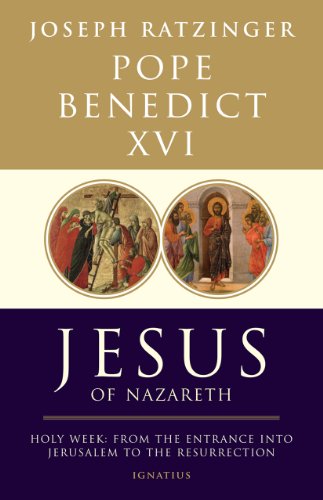
Jesus of Nazareth, Part Two: Holy Week: From the Entrance into Jerusalem to the Resurrection by Pope Benedict XVI

My dad gave this to me as an early Easter gift so that I could read it at the seasonable time of Lent. The individuality and centrality of Jesus Christ comes out so powerfully in Benexict XVI's writings. Certainly, the book gave me a deeper knowledge of how much my life is bound up in Christ's. It consistently presents Him as the One in whose presence every other desire pales to nothingness.

"...a distinguishing feature of the disciple of Jesus is the fact that he
'lives': beyond the mere fact of existing, he has found and embraced the real life that everyone is seeking. On the basis of such texts, the
early Christians called themselves simply 'the living' (hoi zontes).
They had found what all are seeking -- life itself, full and, hence,
indestructible life."

Pope Benedict discusses how Christ created us for this eternal life, made it possible by His death and resurrection, and calls us to life in the Gospels. The pope has impressive scholarly knowledge, but just as evident is his love for Christ, and how entirely his life is bound up in the Kingdom of God.


Milestones: Memoirs 1927-1977 by Joseph Cardinal Ratzinger
How interesting to read about the early family memories of Pope Benedict XVI and his close-call experiences as a youth in Nazi Germany. In one story, he and a group of his comrades were battered by an SS officer trying to make "'voluntary' recruits," but he was sent away (relieved) with "mockery and verbal abuse" because of his stated intention to become a Catholic priest! I also enjoyed seeing the passion he had for his studies in seminary, and how that carried over to his passion for teaching. He wrote with enthusiasm about a great many authors and works, and discussed some of his own first projects. These memoirs confirmed even more for me what a scholarly pope we have.

A Lucky Child: A Memoir of Surviving Auschwitz as a Young Boy
by Thomas Buergenthal
This was a riveting story, and it was, of course, interesting to get inside another personal perspective of World War II and the Holocaust. I've heard the distant, unsympathetic facts of the Holocaust many times before, but a first-hand account brings the tragedy to life. In one part, he describes how his family took in two young children who had lost their parents. In the short time they were together, the children became like his siblings, but it only took a quick gesture from an SS officer and they were sent away to the gas chambers, never to be heard of again. Things like that stood out to me from the book -- the suddenness of his separation from his mother -- the way that life could be going one way and then change so dramatically in only a few moments. In the end, though, I was disappointed at Buergenthal's attribution to fate and fate only.


My Grandfather's Son: A Memoir by Clarence Thomas
I don't normally read this many memoirs, but here is another one I read over the summer. I didn't know much about Justice Thomas, but I had respect and interest for "the silent justice." His memories of the strong, consistent, disciplinary parenting of his grandparents, and especially of Catholic school and serving Mass, held my attention. I learned about the inferiority he felt, even after earning a law degree from Yale. The affirmative action dynamics at the time made him feel that his degree was worthless. He wrote that, "as a symbol of my disillusionment, I peeled a fifteen-cent price sticker off a package of cigars and stuck it on the frame of my law degree...Instead of hanging it on the wall of my Supreme Court office, I stored it in the basement of my Virginia home." His description of the "high-tech lynching" was enlightening. However, he certainly did not paint an idealized version of himself; I was surprised at the candid admittance of faults and acknowledgement of mistakes throughout the book. A disappointment I had was that he didn't give a clear indication of the nature of his faith in the end; however, I thought the book well-worth the read.


Lift Up Your Heart: A Guide to Spiritual Peace by Fulton Sheen
Sheen's writing is like his speaking: passionate, clear, and to-the-point, but not just to any point, to the right one. He hits on the true nature, purpose, and fulfillment of man. He is knowledgable about the field of psychology, and this was one of the first works I read that really connected psychology and spirituality. He exposes the lie that selfishness will bring any kind of peace, and shows how peace can only come from selfless love. He also proclaims unashamedly that selfless love can only come from God. My commonplace book has almost two full pages of quotes from this book; it is full of truisms. Something I especially loved was his line-by-line exposition of parts of Francis Thompson's The Hound of Heaven,which has become a new favorite poem. It's a pleasure to read someone so devoted to Christ who is also so well-read!


Our Lady of Kibeho: Mary Speaks to the World from the Heart of Africa by Immaculée Ilibagiza

Even though I tend to be hesitant about mystics and miracles, it intruiged me that one of the few Vatican approved Marian apparitions took place in a little town in Rwanda. I thought that the prophecies of the genocide were convincing, and I was familiar with Immaculée from EWTN and her book Left to Tell about her experiences of the Rwandan genocide. I expected it to be a good story, but I didn't expect it to delight me like it did. I've had some emotional reservations about Marian devotion, but this story seemed to melt them away. The manner in which she appeared to the children was so simple and motherly. The children felt so surrounded by love that they would laugh and giggle in her presence. She showed intense love for her "children" in the messages she gave, and also wisdom, even though her words were so simple. I enjoyed reading about it from Immaculée's perspective, because she was a child when they apparitions began, and witnessed miracles -- not just physical miracles, but changes in the hearts of her family and village. Reading this book, there's been a change in me as well -- a greater devotion to Christ through Our Lady, and a deepened understanding of the mysteries of the faith through the Rosary and the special Rosary of the Seven Sorrows.

Thursday, April 28, 2011

Significant Books, Part X


What if Heaven's not the afterlife, but rather, earth is the pre-life? This was the epiphany I had when reading Miracles by C.S. Lewis four Easters ago. This book made me consider the supernatural world at an entirely higher level. As a child, my idea of Heaven was a limited little dream world. I imagined flying over green hills, children playing, and a smiling Jesus sitting on a lawn chair. It wasn't a bad prospect, but I don't see it as worth dying a martyr's death.


What if Heaven's not the supernatural, but rather, earth is the sub-natural? This is a passage from the book that I will never forget:

Confusion between Spirit and soul (or "ghost") has here done much harm. Ghosts
must be pictured, if we are to picture them at all, as shadowy and tenuous, for
ghosts are half-men, one element abstracted from a creature that ought to have
flesh. But Spirit, if pictured at all, must be pictured in the very opposite
way. Neither God nor even the gods are "shadowy" in traditional imagination...If we must have a mental picture to symbolise Spirit, we should represent it as something heavier than matter.

A crude analogy of miracles in my mind is the idea of a 3-dimensional person strolling into a 2-dimensional world. He seems to break all the rules; he seems crazy and will probably be killed off. But he is the one with most substance; they simply can't comprehend it.

We are "real" because we are derived from the true Reality, the Existence, the I AM. The common cultural images of God simply won't do. If there is a supernatural Being like that, He must be absolutely terrifyingly unfathomable, but how many of us regard Him in that way?


Thinking about this makes me wonder about the growing belief in "spirituality," but not in God. It seems that we think that, if Nature is the only thing that exists, it must have existed forever self-sustainably, and is therefore somehow spiritual or supernatural. However, that leaves us with spiritual characterizations, but no Character, no Person.

I don't know if that will make sense to anyone reading this; I shied away from writing this post for a long while because Miracles has inspired me to ponder infinity more than any other book, and infinity is impossible to explain, only to expound upon...more...and more...and more...however, I think the expoundings of C.S. Lewis are well worth reading and re-reading.

Tuesday, January 4, 2011

Significant Books, Part IX


This book has helped me understand freedom and love, desire and fulfillment, femininity and masculinity. I never realized how much I needed Mary till I read it. My Protestant heritage did not set up Mary to play a role in my spiritual life. As a new Catholic, I accepted Marian dogmas and devotion; I even defended them, but I didn't really love them till I read The World's First Love by Fulton Sheen.


In Mary I find my vocation as a person. God could work His will through her because she had humility.


My soul doth magnify the Lord / and my spirit hath rejoiced in God my Savior / because he hath regarded the humility of his handmaid.
And she could be perfectly glorified in her Assumption and Coronation because she had no self-glory. She gave everything she was to God, fulfilling her human purpose. This morning, I woke up with hope, because even though it may seem impossible for God to work His perfect will through me, I know He can because He's done it before -- with Mary.

My vocation as a person is to give glory to God, and none to myself. Then my spirit can truly rejoice like Mary in her Magnificat.

In her I find my vocation as a woman.

"She has the vocation of generating life, either in the flesh or in the spirit..." - Chapter 6 - The Virgin Mother
She gave physical life to Our Lord, and she gives spiritual life to the Church as its mother. We are "her offspring, those who keep God's commandments and bear witness to Jesus." (Revelation 12:17)

My vocation as a woman is to give life, which is to give Christ. Mary gave Christ as no other could have possibly done!

"The key to understanding Mary is this: We do not start with Mary. We start with Christ, the Son of the Living God! The less we think of Him, the less we think of her; the more we think of Him, the more we think of her; the more we adore His Divinity, the more we venerate her Motherhood; the less we adore His Divinity, the less reason we have for respecting her." - (Ch. 5)

Saturday, November 27, 2010

Significant Books, Part VIII


The Silmarillion was a book that heightened my idea of mythology and beauty. Sadly, I've read many books just to say I've read them. What do I really expect to get out of a book if my only goal is to finish it? I may have gone into The Silmarillion with this mindset, but it was quickly forgotten. The Valaquenta (about the first 30 pages) was overwhelmingly clear and beautiful to me, so much so that I just turned back to the beginning and read it again. It was like Greek mythology, but holier. There's something so attractive about ancient stories, ones that are told with homage and a sense of reverence. I had experienced attraction to these types of things in my childhood, but this was a direct encounter, and one that changed my perspective toward things. I began to look for pure, ancient, reverent, beautiful qualities in every part of life - stories, music, nature, art, architecture...and even little things like penmanship or turns of phrase. The was something in the aura of The Silmarillion that I desired.

I loved the stories of heroism and romance, the history, the symbolism, the conflict between light and dark, the graceful language (could anyone but a linguist have written so beautifully?).

The greatest reason why I love The Silmarillion is because it helped me realize what I already had. The recent daily Mass readings have been in Revelation - a story with unmatched epic proportions. Why was I so enamored with the the song of the Ainur? Perhaps it's because I long so much for the song of the Lamb. My heart swelled at every thought of Elbereth; then it burst at the thought of my own mother, the heavenly queen with a crown of twelve stars.

What could be a greater conflict than the one between Love and sin? What greater story of heroism than the King of All sending His Only Son to redeem men? What more ravishing romance than the one between the Lamb and His Bride? What deeper history or symbolism than that found in our Scripture? The Psalms are like poems from inside me that spring out when I hear them.

I gradually found that the things drawing me to The Silmarillion were satiated in Christianity, and it was sweet to my mind. But the sweetest thought is that it's only a taster; there is an infinite amount of Truth to be devoured.

Saturday, July 31, 2010

In Love with a Literary Character


Part of the reason why I love books is because they contain so many fascinating characters. There's a man in Around the World in Eighty Days named Phineas Fogg. Fogg is an appropriate surname because nobody quite knows how he functions; however, he always seems to be perfectly at ease, acting like he has the world under control, even under the most absurd of circumstances.

Far From the Madding Crowd contains a man named Gabriel Oake, a character whom I was attracted to because of his simplicity, honesty, and unassuming nature. He works hard and with patience, and his virtue is what brings him out on top in the end.

O Pioneers! is a story about a woman named Alexandra, whose fortitude and strength makes everyone around her depend on her.

Le Morte D'arthur tells the legends of King Arthur. Who can resist stories of a noble king, especially one who will be cut up in battle for the love of his people?


Edmond Dantes wasn't an interesting character until he was unjustly locked up in the Chateau d'If for 17 years. His suffering created him, and he in turn created one of the most intricate plots that has ever been twisted through my brain - The Count of Monte Cristo.

In The House of Seven Gables, all is darkness until Phoebe Pyncheon arrives. She spreads light wherever she goes, not being suffocated by the ghostly death all around her, but permeating the house with new life.

The main character of Pride and Prejudice, Elizabeth Bennett, isn't afraid to say what requires saying, no matter how unconventional or bold it may be.

And one of my favorite literary characters is Alyosha from The Brothers Karamazov. I love him because he has such sensitivity and gentleness, incredibly evident in the way he sees and interacts with children. The love he spoke to them in the final chapter resonated with me so deeply that I wept. And the children couldn't help but love him back.

These are unrelated characters from unrelated books, but they all have qualities about them that make their stories worth reading and remembering. Now of all the books I've read, there's one that stands above the rest--and that is because its main character is the most fascinating one I've ever encountered. Phineas Fogg doesn't hold a candle to the man who walked calmly across the thunderous sea. Gabriel Oake was a meek man, but he didn't bend down to wash the feet of his friends. Did anyone ever say to Alexandra Bergson, "to whom shall we go? You have the words of eternal life"?

Arthur Pendragon was a mighty king, but this man's kingdom "is not of this world." And out of love for his people he was cut up by a crown of thorns. The Count of Monte Cristo had a tragic, mysterious past, but what does it compare to the "man of sorrows...acquainted with griefs"? Betrayed by his friend with a kiss.

Phoebe Pyncheon brought light to a dark place, this man was called "the true light that gives light to every man." Lizzie Bennett had a sharp tongue, but she never turned the tables of the marketplace, accusing the people of making a "den of robbers."

Alyosha Karamazov is only a shadow of the man who said, "Let the little children come to me, and do not hinder them, for the kingdom of God belongs to such as these."

Every trait I have ever loved in any character is found in This One.

What if you fell in love with a literary character and found out that He was real, and that He loved you back?

Wednesday, March 3, 2010

Significant Books, Part VII

The rude, uncomfortable human self-portrait presented in The Screwtape Letters puts me to shame every time I read it. But it's the sort of healthy shame that I need provoked with - the fact that the Creator put in us dignity, purpose and love, and our sin and selfishness are perversions of that.

Lewis shows how "devils" love perversion, confusion, and vacant minds. Haziness and tepidity delight them. They love it when we make God little in our minds, defining our spiritual lives by emotions or social perceptions. But despite their diabolical power, they are entirely crippled by virtue, and especially sincere humility - what Lewis called the "real nakedness of the soul in prayer."
...if he ever consciously directs his prayers "Not to what I think thou art, but to what thou knowest thyself to be," our situation is, for the moment, desperate. Once all his thoughts and images have been flung aside or, if retained, retained with full recognition of their subjective nature, and the man trusts himself to the completely real, external, invisible Presence, there with him in the room and never knowable by him as he is known by it -- why, then it is that the incalculable may occur.
We so often forget that we are serving a fathomless, infinite, incomprehensible Being. If only we would worship Him with awe! The more we fear the Lord, the more we're aware of the stupidity of our sins, but the amazing thing is that the more we stand in awe of our Creator, the more we understand who we are, because we're made in His beautiful image.
Remember, always, that He really likes the little vermin, and sets an absurd amount of value on the distinctness of every one of them. When He talks of their losing their selves, He means only abandoning the clamour of self-will; once they have done that, He really gives them back all their personality, and boasts (I am afraid, sincerely) that when they are wholly His they will be more themselves than ever.
There are so many things addressed in this little book, but one that strikes me especially hard, especially during the season of Lent, is the importance of submitting the will to God. No matter how much I think or talk about loving Him, it's all for nothing if I don't actually obey Him.
The great thing is to prevent his doing anything. As long as he does not convert it into action, it does not matter how much he thinks about this new repentance. Let the little brute wallow in it. Let him, if he has any bent that way, write a book about it; that is often an excellent way of sterilising the seeds which an enemy plants in a human soul. Let him do anything but act. No amount of piety in his imagination will harm us if we can keep it out of his will.
The Screwtape Letters makes the list of my significant books because it opened my eyes to the constant raging of spiritual warfare and heightened my perception of God, not as a someone we define, but as someone who defines us.

Friday, February 5, 2010

Significant Books, Part VI

[Again, this series of Significant Books isn't necessarily my favorite books, but rather, books that have influenced me in my life or shaped my philosophy in some significant way.]

Nearly 6 years ago, I was sitting in my Baptist Sunday School class as the teacher was handing out blank cards to everyone. "We want to make this class interesting and relevant to you," he said, "so write down anything you might want to learn more about, and we'll try to answer your questions in the coming classes." I wrote down the weightiest question on mind--"What is the difference between Catholics & Protestants, and why are Protestants right?"

At that point, Catholicism was a large question mark in my mind--grown larger from my parents obvious interest in it. I knew it was controversial, but I had never heard a clear explanation as to what it was or why it was supposedly teaching a "different gospel."

I was probably more attentive during our next Sunday School class than I had ever been before. Afterward, I was unconvinced. I knew the arguments didn't hold water, and I was dying to know how to answer them. Catholicism and Fundamentalism by Karl Keating was the first book Dad gave me to help answer my many questions. I ate this thing like candy. It solidified all that I knew was right, but couldn't explain till that point. It pointed out the Scriptures and gave a true representation of what the Church taught. For the first year of our conversion, as I searched the Scriptures with new openness, I used this book as a tool to understand what the Church taught about it and why.

This book really didn't change a thing about what I believed. I knew that I was a Christian and I wanted to follow God. But the Church gave me a fuller and deeper understanding of Christianity and the tools to follow God in even more radical ways. It made my Christian faith more of a reality.

The first half of this book exposes the holes in prominent anti-Catholic literature. The second half answers the common accusations against the Church. As I said, it was the first book of its kind I had ever read. It opened the door to MANY other books, and "Catholic apologetics" became one of my biggest passions. Catholicism and Fundamentalism will always be significant to me because it was a gateway for such a huge change in my life.

I am still very passionate about defending and building up the Church; in fact, it is one of the main reasons why I've gotten involved in blogging. After 5 years of being Catholic, I've received so many spiritual (and intellectual) gifts of God through the Church, and few things give me more joy than sharing that with others.

But really, the biggest thing that this book spurred on was not a desire to teach or explain Catholicism to others (though that goes along with it). The most amazing thing I've learned is that I can never stop learning! God is infinite, so we can go on learning about Him and growing closer to Him forever. I want to keep a hunger for the truth and an eagerness to share it.

Wednesday, December 30, 2009

My Year in Books

I love exploring the vast world of classic literature. There's always another book to read (and sometimes it seems like I spend more time making lists of books than actually reading). Here's a list of a few of the books I read in 2009:

The House of the Seven Gables by Nathaniel Hawthorne

Hawthorne doesn't impress me as much with his actual stories as he does in pulling such feeling and poetry out of inanimate objects. It's almost as if the house is a main character--full of history, symbolism, & meaning. His books have a very unique aura that some people find too melancholy, but I enjoy it.

Middlemarch by George Eliot

This was such a pleasant English novel. I felt like I was just observing the lives and interactions in small community without necessarily reading a story, though there were plenty of twists and turns to keep it interesting. I appreciated that it was very driven by characters and dialogue. Eliot is always delightful in a good and simple way.

The Robe by Lloyd Douglas

This was a story about a young Roman tribune who lived during the time of Christ, was present at his crucifixion, and happened to cast lots for his robe. The robe was strange and fascinating to him, and caused him to seek out the truth about who Christ was. I loved the perspective of this story; it gave a fresh outlook on the life of Christ and his early disciples, both Jew and gentile.

Brideshead Revisited by Evelyn Waugh

This was very characteristic of its time in literature--many difficult life questions and a lot of drinking. There are many profound morals to be found in the protagonist's hard reminiscings about the Flyte family (ironically, flyte means "strife"). It shows what happens when religion becomes a mindless tradition. You fail to embrace it, but you can't ignore it, and you deteriorate from the inside. It's not the kind of genre that I typically read, but it's a fascinating rendering of apathy & sin.

The Time Machine by H.G. Wells

It's worth reading simply because it's the archetypal science fiction story. It has all the important characteristics of the genre. There are some insightful points on societal development, though philosophically the existence of God & thus the God-given nature of man is out of the picture. Still, it's an interesting read & significant literary piece. Besides, who can resist the enticement of time travel?

The Lord of the Flies by William Golding

There's no question that it's a gruesome story. Power, strife, greed, & the tendencies of man in society are nasty topics, and they're described crudely in this book with the title that means "Beelzebub." It's an exaggerated allegory that's rudely provoking (and probably a huge turnoff to literature for high school kids who are forced to read it in school...)

The Grapes of Wrath by John Steinbeck

This is another rather crude book. (It seems like there was a lot of that this year, mostly because I've been focusing on reading well-known classics & books commonly used in the classrooms.) I appreciated this story, not really for its literary themes, but for its historical exposé, which I thought was brilliantly poignant. The last chapter was heart-rending. Simply put, it was an eye-opening masterpiece of misery.

The Great Gatsby by F. Scott Fitzgerald

Like Brideshead Revisited, this story was full of tormented minds and too much wine. It shows the shallow emptiness beneath the glittery American dream of the Roaring Twenties. Yes, the story was affecting, but unlike Brideshead, there was no hint of a redeeming entity.

Gone with the Wind by Margaret Mitchell

Here's another classic novel that I appreciate more for its insights into an historical era than for its literary themes. It's the story of a proud, self-absorbed Southern belle named Scarlett O'Hara. (I think it's the only story I've read with such a villainous protagonist!) I appreciated the reliable constancy of the characters. Each were predictable (or predictably unpredictable), and they all added to the story in their own way.

The Scarlet Pimpernel by Baroness Orczy

What a clever, charming little book! It was very engaging and entertaining; plus, the French Revolution was a fascinating time in history. I think I'd be a great book to read out loud my children someday.

The Brothers Karamazov by Fyodor Dostoevsky

I can really only handle one massive Russian novel a year. They are so heavy--literally & figuratively, but they're entirely worth the effort. This book was my favorite of the year. The psychology of the characters, their detailed thoughts & interactions, and the resolutions of their fates were so interesting. There were some beautiful and profound passages, and some scenes that were perfectly cutting. The ending was so lucid and very stirring for me. It's one of those books that I hope to read again someday, and I know I'll get even more from it.

I'm glad I got a chance to write down my thoughts about some of this year's books, because to be honest, I have a pretty poor memory, so hopefully my notes will be able to refresh me on them in the future. I hope 2010 will have even more great books in store! I've been accumulating a lot of good non-fiction as well, and I'm looking forward to reading and learning lots more!

Happy New Year!

Sunday, November 29, 2009

The Spirit of the Liturgy (Significant Books, Part V)

It being the first Sunday of Advent and the beginning of the new liturgical year, I thought it'd be fitting to write about The Spirit of the Liturgy by Cardinal Joseph Ratzinger (now Pope Benedict XVI). I read this exactly 2 years ago, so a lot of the details have left me. I hope I'll re-read it at some point, but the important thing is that the big picture has always stayed with me and inspired my thoughts at every Mass and every late stargazing night.

Liturgy, in practical terms, comes from the Greek leitourgia meaning "to perform public duty." Basically, it's the outward manifestation of faith. It's expressed by the Church most radically through the Mass, the celebration focused entirely on Christ's Eucharistic sacrifice. All liturgy points to Christ:
"...Christian worship is the practical application and fulfillment of the words that Jesus proclaimed on the first day of Holy Week, Palm Sunday, in the Temple in Jerusalem: 'I, when I am lifted up from the earth, will draw all men to myself' (Jn 12:32)." - Chapter II
The liturgy is the celebration of Christ's sacrifice and our salvation - the cross and resurrection makes our communion with God possible. The liturgy is about God and man touching each other. It's our taste of heaven (literally). It's a mystery and it's a romance.
"The Christian theology of worship--beginning with St. John the Baptist--sees in Christ the Lamb given by God. The Apocalypse presents this sacrificed Lamb, who lives as sacrificed, as the center of the heavenly liturgy, a liturgy that, through Christ's Sacrifice, is now present in the midst of the world and makes replacement liturgies superfluous (see Rev 5)."
Our life on earth is just a preliminary to eternity. Our true home is in heaven. I love this word picture at the beginning of the book:
"Children's play seems in many ways a kind of anticipation of life, a rehearsal for later life, without its burdens and gravity. On this analogy, the liturgy would be a reminder that we are all children, or should be children, in relation to that true life toward which we yearn to go. Liturgy would be a kind of anticipation, a rehearsal, a prelude for the life to come, for eternal life...Seen thus, liturgy would be the rediscovery within us of true childhood, of openness to a greatness still to come, which is still unfulfilled in adult life."
This book was so profound for me because it showed how God uses the physical world to communicate with us. In bowing, kneeling, extending our hands in prayer...we are literally revering God with our bodies. We are tangible people, so God communicates with us in tangible ways, through art and music, through spoken and written words, through time changes & seasons, through nature, through bread. He wants to unite Himself with us, and every part of the liturgy is an expression of that. It's LITERAL - it's so very, very real. But the best part about it is that heaven will be even more real, and its beauty will never be exhausted.

Tuesday, October 13, 2009

Significant Books, Part IV (The Everlasting Man)

"On the Man Called Christ."

The paradoxical, yet universal nature of Christ is both mystifying and so fulfilling.
"It revolutionised their very vision of revolution; and turned their very topsy-turvydom topsy-turvy."
Why is Christ is any different from other men? Why Christianity is different from any other "religions?" The reason is that myth and truth are united in that person of Christ.
"...in reality the rivers of mythology and philosophy run parallel and do not mingle till they meet in the sea of Christendom...there has never before been any such union of the priests and the philosophers."
Men wrote myths because they longed for the story in which God touches man. Never did they dream that God would actually become man, and make Himself so man could touch Him.
"It met the mythological search for romance by being a story and the philosophical search for truth by being a true story."
The polytheism of the Greeks & Romans was a search to fulfill the imaginative side of man, but it could do little for the realistic side. The principles & proverbs of the ancient Orientals sought to fulfill the philosophical man, but couldn't satisfy his wild imaginings.
"The philosophy of the church is universal...Had Plato and Pythagoras and Aristotle stood for an instant in the light that came out of that little cave [the stable], they would have known that their own light was not universal. It is far from certain, indeed, that they did not know it already. Philosophy also, like mythology, had very much the air of a search...For it is the paradox of that group in the cave, that while our emotions about it are of childish simplicity, our thoughts about it can branch with a never-ending complexity. And we can never reach the end even of our own ideas about the child who was a father and the mother who was a child."

Thursday, September 24, 2009

Significant Books, Part III (The Everlasting Man)

As I was going through my list of "significant books," I decided to post about The Everlasting Man by G.K. Chesterton next. Ha! That was a month ago. In preparation for the intended entry, I decided to browse through the book again to refresh my memory. That turned into a full-blown re-reading along with copying passages & taking notes. Whoops.

The book has a pretty wide spectrum of topics, but it all comes back to a central point. Anthropology, history, art, religion, mythology, tradition - it all points to Christ. And no person seems to be able to convey this with as much common sense, humor & wit than Chesterton.

Humans seem to have some trace of supernatural in them. At the very least, the supernatural has always had a mesmeric hold over us. We seem always to point to the sky. Humans are strange, unprecedented creatures. As Chesterton puts it:
"There may be a broken trail of stones and bones faintly suggesting the development of the human body. There is nothing even faintly suggesting the human mind." -Chapter I (The Man in the Cave)
Somehow, we're so like animals, yet so unlike them. How did we come to be so different? Was it millions of years of evolution? Chesterton drily suggests that no matter how long a cow grazes on the hillside, it will never build its own cow-shed; no matter how long a sheep is in a pasture, it will never develop ancestor-worshiping practices. The phenomenon is not justified or explained any more by a million years than it is by a day. The fact still remains that it is an incomprehensible phenomenon. And where did our unnatural tendencies come if not from an unnatural (or supernatural) being?
"The simplest truth about man is that he is a very strange being; almost in the sense of being a stranger on the earth. In all sobriety, he has much more of the external appearance of one bringing alien habits from another land than of a mere growth of this one. He has an unfair advantage and an unfair disadvantage. He cannot sleep in his own skin; he cannot trust his own instincts. He is at once a creator moving miraculous hands and fingers and a kind of cripple. He is wrapped in artificial bandages called clothes; he is propped up on artificial crutches called furniture. His mind has the same doubtful liberties and the same wild limitations. Alone among the animals, he is shaken with the beautiful madness called laughter...It is not natural to see man as a natural product."
Oh, I shouldn't start quoting or I won't be able to stop! I might as well just tell you to drop what you're doing and read The Everlasting Man right this moment. Seriously, just read the first chapter - The Man in the Cave. It contains enough profound wisdom to fill 50 books. I would be content to simply read it over and over again. Even the short paragraph of the metaphor of man and mirror overstimulates my brain with amazement.

And yet that's only the beginning of the first half of the book - "On the Creature Called Man." The second half is "On the Man Called Christ."

It looks like this is going to be more than one entry...

...I can't resist just one more quote!
"Behind all these things is the fact that beauty and terror are very real things and related to a real spiritual world; and to touch them at all, even in doubt or fancy, is to stir the deep things of the soul."

Thursday, July 30, 2009

Significant Books, Part I

Literature is an influential part of me. What I'd like to do is go through the list of my "significant books" and write about each. This list doesn't necessarily contain my "favorite" books. It's the books that have significantly shaped the way I think, contributed to my philosophy, or introduced important ideas to me. I thought this would be the best place for me to begin this new blog of mine.

The Holy Bible.

This is the one that I've read, listened to, studied, prayed, pondered, argued over, and loved the most. :) I grew up on it, memorized it as a child, practiced my penmanship with it, got chastised with it, and listened to hundreds of sermons on it. It would be impossible to extract it from my life and me remain the same person.

From a literary point of view, it contains all the things that I love. It's a historical masterpiece. Not only that, but it tells the story of a family. One of my favorite series as a child was something like "American Adventures" that began with two children going on the Mayflower. The next book was about their children, the next about theirs, and so on. I found it so fascinating! The Bible begins with the first man, continues with his children, and goes on to give the story of their descendants (Abraham, Isaac, Jacob, and the 12 tribes of Israel). It follows the line of the Hebrews till it comes to the crux - Christ, on whom the fates of all humanity depend. It's the story of the whole human family - the ultimate genealogy!


One of the biggest things that I look for in any story is an ending that comes out of the beginning. (This is the main reason why you'll see Les Miserables is on my list...more on that when I get to it). A good story is bookended, crafting a conflict and resolving it. The Scriptures have the ultimate plot conflict: human sin, and the ultimate plot resolution: Christ. The entire Old Testament is a masterful story of the Hebrews and their struggles. The New Testament answers the Old, reconciling men to God, and ends with a ravishing prophecy of that eternal reconciliation.

A good book will also cause the reader to reflect on themselves and on the world, and will challenge the person to change them in some way. What could be more radical than the challenge to become like the crucified Christ?

The symbolism is deep and the foreshadowing ingenious. Any lover of literature must be in awe of the creative mystery conceived by the Scriptures.

I want to end with this profound quote from C.S. Lewis (a man whose books have influenced my philosophy tremendously). He wrote it in a letter to his friend Arthur Greeves in fall of 1931, talking about the Gospel as it stands in relation to other human stories (or rather, mythologies):


"Now the story of Christ is simply a true myth: a myth working on us in the same
way as the others, but with this tremendous difference that it really happened:
and one must be content to accept it in the same way, remembering that it is
God’s myth where the others are men’s myths: i.e. the Pagan stories are God
expressing Himself through the minds of poets, using such images as He found
there, while Christianity is God expressing Himself through what we call “real
things”. Therefore it is true, not in the sense of being a “description” of God
(that no finite mind could take in) but in the sense of being the way in which
God chooses to (or can) appear to our faculties."
I suppose this is why humanity is so attracted to stories, because they mirror this beautiful "true myth" that God wrote. I only wish that more people could appreciate and love it as much as I've learned to love it.