Friday, March 6, 2015

Future Societies and Servitude


There's always something chilling about a futuristic novel, even when its motif is heat and fire. Ray Bradbury's Fahrenheit 451 takes readers to a progressed society where houses are fireproof, and firemen protect the city by burning the threats to its happiness and security. What are those threats? Ideas. Books. Each one has something in it that offends someone else - makes them unhappy. The authors disagree amongst themselves and therefore hazard peace.
Ask yourself, What do we want in this country, above all? People want to be happy, isn't that right? Haven't you heard it all your life? I want to be happy, people say. Well, aren't they? Don't we keep them moving, don't we give them fun? That's all we live for, isn't it? For pleasure, for titillation? And you must admit our culture provides plenty of these.
The people live leisurely with giant TV walls and constant surround sound. Worries hardly exist. Each house is well-stocked with sleeping pills. If children are born, they're placed in school as infants. No one argues about politics because running the country is someone else's job to worry about. No one has to undergo the unpleasant act of thinking.

We must all be alike...Every man the image of every other. Then, all are happy, for there are no mountains to make them cower, to judge themselves against. So, a book is a loaded gun in the house next door. Burn it. Take the shot from the weapon. Breach man’s mind. Who knows who might be the target of the well-read man. Me? I won’t stomach them for a minute. And so when houses were finally fireproofed completely all over the world…there was no longer need of firemen for the old purposes. They were given the new job as custodians of our peace of mind, the focus of our understandable and rightful dread of being inferior.
Aldous Huxley's Brave New World is an even eerier utopia. The government has no need to burn books; it conditions the citizen's subconscious to hate them. A human reproduction factory spits out clone groups, and with scientifically precise methods, designs their bodies and brains to do certain tasks. And not just to do those tasks, but activate the most possible pleasure sensors by doing it. So no military force is required to keep vast populations in slavery; they willingly submit. As Huxley wrote:

“A really efficient totalitarian state would be one in which the all-powerful executive of political bosses and their army of managers control a population of slaves who do not have to be coerced, because they love their servitude.”

These clones also have every sensual pleasure available to them. The "Feelies" are movie theaters that bring all 5 senses into an alternate reality. "Soma" is their perfect drug, whisking them into a chemical alternate reality rather than a technological one. And with all these diversions, the citizens are "happy."

In both of these novels, freedom is exchanged for comfort. Individual thought for security. Life for "happiness." In the first part of the 20th century, both Bradbury and Huxley saw these exchanges begin to occur. In 2015, they are frighteningly evident in the new moral code of society where what "feels good" is considered morally good. In fact, I know several friends who would probably not find these futuristic societies offensive at all, but see them as hopeful ideals where people can finally do what they please without experiencing pain.

Then why were they intended as horror stories? I think it's because we understand that pleasure is not an end in itself, but a means to a greater end. That a life of merely endless entertainment, sex and drugs is somehow beneath us. At the end of Fahrenheit 451, Guy Montag is aptly dubbed "The Book of Ecclesiastes," which opens with the refrain "Vanity of vanities! All is vanity!" John Savage, at the end of Brave New World, tries to convince the crowd of the vapidness of their indulgence. But then what is the end of pleasure if not to fulfill us?

For the Christian, pleasure is a glimpse of Heaven, something to remind us of the coming joy that truly will fulfill. A Christian enjoys pleasure more than anyone else, knowing its meaning, and he can go without it with more joy, knowing that it's not a necessity or end. Lent is a great example of this. From the outside, fasting seems like bondage, but in reality the fasting keeps us free of the bondage Bradbury and Huxley describe. We don't need the constant outside stimulation because we have a more lasting food. So how will our society avoid Bradbury and Huxley's dire forecast?
Jesus said to them, "I am the bread of life. He who comes to me shall not hunger, and he who believes in me shall never thirst."

Tuesday, February 10, 2015

An Unlikely Patroness

Why do I relate so much to an elderly mother who lived in a time and culture entirely removed from my own? I barely know any details about her, but after hours spent meditating on a single event from her life, there are so many ways St. Elizabeth inspires me. 


First, because she was "advanced in years," Elizabeth was unfit for the task of carrying a baby. Her body was weak. Not only was it impossible for her to conceive without supernatural help, but she required human assistance (from Mary) to carry the pregnancy to term. I may not be literally carrying a child, but there are 52 children under my care every day in the classroom, and I am unfit to teach them. My weaknesses make it impossible for me to give them what they need. The visitation gives me peace by reminding me that God calls and works through the weak, no matter how unfit for the task.
"When Elizabeth heard Mary's greeting, the infant leapt in her womb, and Elizabeth [was] filled with the Holy Spirit..." 
Second, my greatest desire for my students is that they recognize Christ as their Lord and follow him. Sometimes I despair of their ever coming to know Christ in their tragic circumstances and disordered family lives. But if the infant John could recognize God even in the darkness of the womb, I can have confidence that the Holy Spirit reveals his presence to the simplest of minds in the darkest of places. 

Third, the joy of the visitation is all the more clear when we realize how long Elizabeth desired and waited for a son. At my stage in life, many hopes and longings are deferred. Meditating on this mystery broadens my view so that, rather than regretting the wait, I can trust God's plan to fulfill every desire in ways beyond my imagination, just as he did St. Elizabeth's. And may my daily prayer echo hers:
"Most blessed are you among women, and blessed is the fruit of your womb. And how does this happen to me, that the mother of my Lord should come to me?"

Monday, January 26, 2015

Trifles

   I recently read the George Eliot novel The Mill on the Floss which tells the story of young Maggie Tulliver, a spirited, impulsive girl who idolizes her older brother Tom more than anyone in the world. As she gets into her many scrapes, the grown-ups complain of her unruliness and, try as they might, fail to keep her under control. Tom grows older, becoming more proud and serious, and joins the adults in their scolding and rebukes.
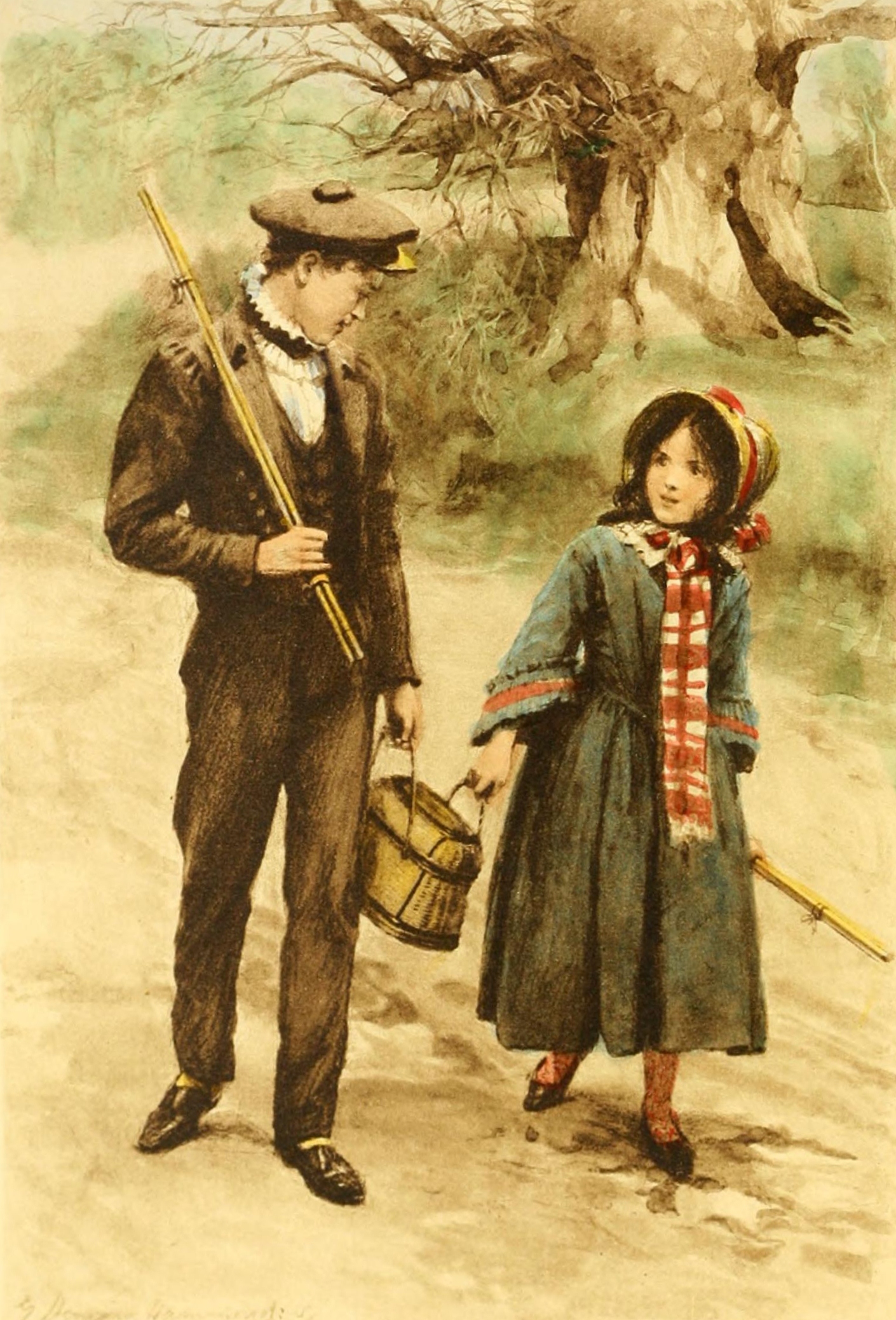
http://upload.wikimedia.org/wikipedia/commons/1/12/Tom_and_Maggie.jpg
   Little do they know the inner tumult Maggie experiences each time she falls out of grace with her brother.  They don't see how desperately she wants to be good so she can please him, or how a single harsh word from Tom can make her feel like the the sun has gone out in her world.

   The book describes the intensity with which she feels all these things, but Mrs. Tulliver and the disapproving aunts write off Maggie's despairs as trifles. And on the surface, they are trifling: a cold glance from Tom, a forgotten token, a spoiled afternoon plan. They're almost nothing compared to the troubles of the grown-ups. 

   But just because her troubles are smaller doesn't mean they're any less painful. Maggie is smaller, and all her woes are proportionate to herself. It only takes a little water to fill a short glass, but nonetheless it is still full. 

   In self-reflection, I was a bit rattled when I recognized Mrs. Tulliver in my own life. When children come to me with their troubles, I'm guilty of belittling their experiences: "That's not so bad compared to ______," I do want to help them get a right perspective of the world, but I also realize that I need to acknowledge those "trifles" as seriously as they do.  
Tom & Maggie from The Mill on the Floss


Sunday, January 11, 2015

A Student in God's School


Educators often talk about that 'magical moment' when a student finally grasps something - when the 'lightbulb comes on.' They'll say it's the main thing that inspires them, the motivation to get through all the planning & grading, paperwork & legal labyrinths & tests. Like any teacher, I love the moments when I can see things 'click,' but there are moments that I cherish far more than that.

I teach on an 'intervention team,' which means that many of my students are 2-3 years below grade level. They all face unique challenges to learning, from troubled homes to learning disabilities. They go through erasers like candy because almost nothing comes to them on the first try. To them, giving up is a tempting relief, a safe place where they can get away from difficulty & failure. So in my day to day work with them, the moments that touch me most aren't when they earn a good grade or a sticker for mastery. It's the ones where they receive the familiar F, but then pick up their pencil to fix the mistakes. The ones where I ask, "Does that make sense?" and they answer, "No, not really," expectantly waiting for me to try another explanation. The disappointment when they miss a problem, but sigh resolutely and start again. I'm touched by those moments because I know how much they want to give up and how impossible it feels to them, yet they keep trying. 

In my own spiritual life, I have many moments of giving up - times when I mess up so badly that it doesn't seem worth it to drag myself back to God and ask forgiveness. I feel the impossibility of living the Christian life because of the sheer number of times I commit the same stupid sins. I avoid prayer or confession because I don't want to go through the process of starting over again. I imagine the disgust God must have for me, how tired he must be of putting Fs on all my life's tests. But then I realize that no matter how many failing grades I give to my students, the last thing that I want them to do is give up. I think of how much I want them to ask for help when they've messed up, and how proud I am when they ask for my big eraser so they can try again.

The love I have for my students is nothing compared to the love God has for his children. It gives him joy when we come back to him no matter what we've done or how many times we've done it.
But the father said to his servants, ‘Bring quickly the best robe, and put it on him; and put a ring on his hand, and shoes on his feet; and bring the fatted calf and kill it, and let us eat and make merry; for this my son was dead, and is alive again; he was lost, and is found.’

Thursday, July 3, 2014

Women and Men

It's a rare and special occasion when all 32 members of an extended family can be together. Thirty-one of us were present at a graduation party in May, many of the ladies reunited a few weeks later for great-grandchild #1's baby shower, and a family vacation saw us all reunited in the Wisconsin Dells last week. For some reason I really took notice of my aunts and uncles during those times. So many of the cousins are transitioning to adult life and experiencing growth and changes. Maybe because my perspective has changed, or because my parents' generation is also going through transitions, or maybe because of a combination of both - their words and actions struck me in ways I'd never noticed before.

The women in my family are home-makers - not in the sense that they're always at their house, but they're always making others feel at home. I was so impressed as my Aunt Cindy hosted a large group of women at the baby shower, providing food and facilitating games. She managed to make everyone feel welcome, even being attentive to Vanessa's mother-in-law, only present via Skype and watching through a laptop.

And then somehow, within 5 minutes of entering our condo in Wisconsin, Aunt Jenny had the kitchen stocked and organized, with snacks out on the table. I was amazed at the hospitality each of these women had even when they were so far away from their homes! They anticipated the little things all the way from seating arrangements to serving spoons.
The men in my family are spiritual leaders. Uncle David initiated scripture-reading and prayer over the 6 graduates (college & high-school) at the party. He invited others to give words to the graduates, and every single head of family spoke up. As I listened, I realized how easy it would have been for them to leave the "words" to their wives - most of whom did share eloquently. I realized how much easier it would be for them to let all the teenagers go back to goofing around and eating cupcakes. But their love for their children came through as they seized those moments to share the most important message of all - love God and follow him.

My grandpa asked each of his sons & sons-in-law to lead one night of family devotions during our vacation. Again, my dad and uncles took the opportunity to exhort and challenge us in our faith. My older cousin, the only one married so far, is quiet and reserved, but none the less a leader. He added his own exhortations, as the head of his own young family, for us cousins to marry a man or woman of God. There are so many other ways that these men are leaders, but I particularly respect the fact that they lead by speaking and praying.

It's a rare and special occasion when all 32 members of an extended family can be together. It's even more special when that family is held together by such faithful women and men.

Monday, March 17, 2014

Lenten Inspirations

See if you can pick up on the theme here.


"Conquer yourself each day from the very first moment, getting up on the dot, at a set time, without granting a single minute to laziness. If with the help of God, you conquer yourself in the moment, you have accomplished a great deal for the rest of the day. It's so discouraging to find yourself beaten in the first skirmish." - St. Josemaria Escriva 


"Thus with the baggage of the world I was sweetly burdened, as one in slumber, and my musings on thee were like the efforts of those who desire to awake, but who are still overpowered with drowsiness and fall back into deep slumber. And as no one wishes to sleep forever (for all men rightly count waking better) -- yet a man will usually defer shaking off his drowsiness when there is a heavy lethargy in his limbs; and he is glad to sleep on even when his reason disapproves, and the hour for rising has struck -- so was I assured that it was much better for me to give myself up to thy love than to go on yielding myself to my own lust. Thy love satisfied and vanquished me; my lust pleased and fettered me. I had no answer to thy calling to me, "Awake, you who sleep, and arise from the dead, and Christ shall give you light." On all sides, thou didst show me that thy words are true, and I, convicted by the truth, had nothing at all to reply but the drawling and drowsy words: "Presently; see, presently. Leave me alone a little while." But "presently, presently," had no present; and my "leave me alone a little while" went on for a long while. In vain did I "delight in thy law in the inner man" while "another law in my members warred against the law of my mind and brought me into captivity to the law of sin which is in my members." For the law of sin is the tyranny of habit, by which the mind is drawn and held, even against its will. Yet it deserves to be so held because it so willingly falls into the habit. "O wretched man that I am! Who shall deliver me from the body of this death" but thy grace alone, through Jesus Christ our Lord?"- St. Augustine


Monday, March 10, 2014

Don Bosco


For the past month or so I've been reading this book over my bowl of granola and yogurt every morning. The biography is about St. John Bosco - the priest who worked with poor youth in the streets of Turin during the 19th century. As a first-year teacher, it's glaringly apparent to me every day how much I have yet to learn about God, life, work, people, and of course, especially children. Don Bosco has led me through some of those necessary lessons, and has given me an invaluable source of inspiration for my daily walk.

The first lesson comes from Don Bosco's tireless work for the kingdom of God. As a young seminarian, he wrote these resolutions:
-I shall be rigorous in the use of my time.
-When it is a question of saving souls, I shall suffer, work, and humble myself.
-Since work is a powerful weapon against the enemies of my soul, I shall not take more than five or six hours of sleep.
Not only did he live out these resolutions in the seminary, but through his whole ministry, so much so that at age 72, his doctor declared, "He is a man who is already dead from fatigue, but who continues to work day after day, eat little and live." This man understood the urgency of God's work, and how vastly superior God's eternal kingdom was to his own comfort and pleasure. As a single person living on my own for the first time, opportunities for self-indulgence abound. Hard enough as it already is to keep from centering life on oneself, the world is actively promoting the "me lifestyle." This saint reminds me of the grand picture - why we are really here on this earth - and how serving God and others is the most difficult, but only fulfilling path. Don Bosco took the word of God seriously by sowing acts of righteousness, and he reaped abundant fruit during his lifetime and still today through the Salesians.

The second lesson is that I should not be afraid to communicate that grand picture to others, even children. Don Bosco was chastised by many outsiders for the candid way he spoke to the boys at the oratory. He impressed upon them the gravity of their sin and necessity of frequent confession, often challenging them with questions such as,
"If you were to die tonight, what would happen to your soul?"
Through visions, Don Bosco often foresaw impending deaths. Gathering his boys, he would warn them one was to die soon, and pleaded with every one to commend their whole souls to God, confess their sins, and prepare for the hour of death. Some thought this was too harsh and morbid a tone to take with children, but Don Bosco knew that it was unjust to tell them otherwise. Through his intercession, my prayer is that in daily interactions with students, I will be able to see them as they are - eternal souls - and earnestly and lovingly tell them the truth.

And finally, a third thing I took from Give Me Souls, is renewed desire to hand over every one of my intentions and works to God's glory.
"If the work is for the glory of God, spend all you have and even borrow more. If it isn't, don't spend a cent, for Providence will not help you."
This book is scattered with miracle after miracle - all the different ways God provided for Don Bosco's efforts. I know that if I want my efforts to see success, I must submit them entirely under the will of the Father (which sometimes might mean changing the efforts entirely) before I get to see the marvels he's prepared!