Saturday, July 31, 2010

In Love with a Literary Character


Part of the reason why I love books is because they contain so many fascinating characters. There's a man in Around the World in Eighty Days named Phineas Fogg. Fogg is an appropriate surname because nobody quite knows how he functions; however, he always seems to be perfectly at ease, acting like he has the world under control, even under the most absurd of circumstances.

Far From the Madding Crowd contains a man named Gabriel Oake, a character whom I was attracted to because of his simplicity, honesty, and unassuming nature. He works hard and with patience, and his virtue is what brings him out on top in the end.

O Pioneers! is a story about a woman named Alexandra, whose fortitude and strength makes everyone around her depend on her.

Le Morte D'arthur tells the legends of King Arthur. Who can resist stories of a noble king, especially one who will be cut up in battle for the love of his people?


Edmond Dantes wasn't an interesting character until he was unjustly locked up in the Chateau d'If for 17 years. His suffering created him, and he in turn created one of the most intricate plots that has ever been twisted through my brain - The Count of Monte Cristo.

In The House of Seven Gables, all is darkness until Phoebe Pyncheon arrives. She spreads light wherever she goes, not being suffocated by the ghostly death all around her, but permeating the house with new life.

The main character of Pride and Prejudice, Elizabeth Bennett, isn't afraid to say what requires saying, no matter how unconventional or bold it may be.

And one of my favorite literary characters is Alyosha from The Brothers Karamazov. I love him because he has such sensitivity and gentleness, incredibly evident in the way he sees and interacts with children. The love he spoke to them in the final chapter resonated with me so deeply that I wept. And the children couldn't help but love him back.

These are unrelated characters from unrelated books, but they all have qualities about them that make their stories worth reading and remembering. Now of all the books I've read, there's one that stands above the rest--and that is because its main character is the most fascinating one I've ever encountered. Phineas Fogg doesn't hold a candle to the man who walked calmly across the thunderous sea. Gabriel Oake was a meek man, but he didn't bend down to wash the feet of his friends. Did anyone ever say to Alexandra Bergson, "to whom shall we go? You have the words of eternal life"?

Arthur Pendragon was a mighty king, but this man's kingdom "is not of this world." And out of love for his people he was cut up by a crown of thorns. The Count of Monte Cristo had a tragic, mysterious past, but what does it compare to the "man of sorrows...acquainted with griefs"? Betrayed by his friend with a kiss.

Phoebe Pyncheon brought light to a dark place, this man was called "the true light that gives light to every man." Lizzie Bennett had a sharp tongue, but she never turned the tables of the marketplace, accusing the people of making a "den of robbers."

Alyosha Karamazov is only a shadow of the man who said, "Let the little children come to me, and do not hinder them, for the kingdom of God belongs to such as these."

Every trait I have ever loved in any character is found in This One.

What if you fell in love with a literary character and found out that He was real, and that He loved you back?

Saturday, July 17, 2010

Tactility

The simplest way to say this is: Catholicism has blown open my spiritual life.

I tend to rationalize through my temptations; reconciling my mind to the sin. Imagine the weak mind and flesh reaching for some forbidden fruit, but then making the Sign of the Cross. It's a powerful, physical, paralyzing symbol. When I make it over myself I remember to whom I've entrusted body, and it saves me.

When I enter into the church to pray, I often come feeling foolish and ashamed for my selfish failings. Imagine entering, bent with the weight of self, but then seeing the font filled with Baptismal water. Immersing my hand and raising it dripping, I remember who washes me, and how He leads me to pass from old to new.

I hold a rosary and finger the beads; I walk between the 14 images of the stations of the cross; I touch a relic of the bone of a saint; I smell the chrism; I light the candle; I stand and bow and sit and kneel; I fast before every Mass to eat the Eucharistic meal.

Catholicism has captivated me with its corporeal symbols - its sacraments.

A sacrament is a visible sign of God's grace. The Blessed Sacrament is the ultimate sign of God's grace - Christ's tactile, physical body sacrificed for us. This is our Salvation! The Catholic Church constantly presents this Salvation over and over again through its sacraments.

It amazes me how such a huge, complicated thing like the Church can one single point to which everything leads. It's Jesus Christ, the man, the world's Salvation. And He is so real and tangible that we can feed on His saving flesh.

Saturday, May 22, 2010

My Idea of a Man

There's someone in my life who's very imperfect. But my idea of a man is someone who will return to Christ continually, despite failures. This takes humility.

When I think of the word "masculine," I think of my dad. He "mans up" to his failures because he knows the Truth. When someone knows the Truth, it should humble them, not make them prideful, because the Way, the Truth, and the Life is the powerful One to whom every knee must bow.

My dad taught me about how the Truth is infinite and perfect. If we're going to enter it, we have to be humble, or we can't be changed by Him.

I am a person who struggles with pride, and sometimes the monster seems so unconquerable that I imagine it's useless to keep returning to God. But my dad demonstrates to me that it is NOT useless - that, in fact - it is the returning to God that defines you, and not the sin. The faith of my father feeds me hope every day.

My idea of a man is someone who treats me as an unrepeatable soul. And my idea of a man is someone who can treat me like a sister. My dad does both of these things; he affirms me every day in so many different kinds of ways.
-hugging and kissing me
-thanking me
-telling me I'm pretty
-poking fun at me with his dumb puns
-working hard for me
-reading things I read
-reading things I write
-being honest and willing to address all problems (because he truly cares)

And he calls me his sister in Christ.
-he respects me & wants to know what I think
-encourages my femininity
-advises and prays for me

The most masculine thing that my dad does is lead his family toward Christ. Not just spiritually, but physically! He guided me to the Eucharist, and he leads all of us to the Eucharist every week. He's the one helping us to heaven and I love him for it.

Thursday, April 29, 2010

What is the value of faith?

The things I love the most about our faith are the things I don’t know. Mysteries the substance for which I hunger and feed upon. This is why the Rosary touches me in such a profound way. Only recently, while drudging my way through some novenas (yes, drudging) have I started to truly realize the value of its mysteries.

Besides the glorious, sorrowful, joyful, & luminous mysteries, there are also three little Aves at the beginning of the Rosary where (I’m told) we are to pray for the virtues of faith, hope, and love. These virtues are mysteries in themselves.


When praying these Aves, I would often have in mind 1 Corinthians 13:

At present we see indistinctly, as in a mirror, but then face to face. At present I know partially, then I shall know fully, as I am fully known. So faith, hope, love remain, these three; but the greatest of these is love.

Because love is the greatest, I used to pray more fervently for that virtue than for the other two. They didn’t seem as important. In fact, I sometimes wondered how faith and hope were even useful.


When praying my novena, which was for the faithless, I started thinking about faith in a different light. I realized that they were hopeless because they were faithless. They couldn’t have hope because they didn’t believe in it.

What do we have hope in? We hope for the greatest of these, the greatest desire of our hearts – Love.


So we must have faith in hope, and hope in love. They lead to each other, and they can't be separated. At present we know only partially, but someday we shall know fully!

Monday, March 29, 2010

The Shores of Valinor

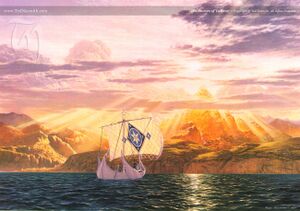
The description for this blog is "these are the things that intrigue and inspire me." I suppose it's obvious that I'm mostly inspired by books, but there are an endless amount of things that catch my interest. One thing that's been affecting me lately is this painting by Ted Nasmith:


It's been my desktop image for a week, and I keep noticing more things I like about it. Aesthetically, I love the width of the landscape, the majesty of the mountains & clouds, and especially the depth & lustre of the sea. But more than that, I love how the light at the top of the mountain is bright, but hidden. You can see that there must be a great canyon beyond the brink, but that too is hidden. The scene is beautiful, but it heightens your desire to see more. I also love the subtle details like the waterfall on the mountainside and the birds flying between the ship and the shoreline. If you look closely, you can see figures on the ship, clasping each other with their arms outstretched toward the light.

The title of this piece is The Shores of Valinor. It is inspired by The Silmarillion (so I suppose it's literary as well as artistic...of course it would still have to do with books...) Valinor is, in some ways, the paradise of Middle-earth. What the painting signifies to me is the heavenly fulfillment of our desires for greatness & beauty. Heaven will be everything our hearts have ever longed for because it will be complete unity with God. When I was little, I remember not wanting to go to heaven because I didn't want to leave all the delights of earth. But what I didn't realize was that heaven is all the delights of earth multiplied by infinity.

The couple on the ship have made a journey - a long, difficult journey - and have depended on each other to complete it. They have two arms reached out in rapture and two arms grasping each other. To me it's a picture of true friendship. The aim of true friends is to help each other reach Heaven - union with God. And that's what a marriage of two souls should always be.

Those are just some of the things that have been going through my head as I've logged onto my computer every day. ;) It's good to have a constant reminder to set my thoughts on worlds far off / where we only cry from joy.
Set your sails upon the mighty winds of May
Set your sails upon the hope of June
Set your sails upon the air of warm July
Set your course for Heaven's shore!
- Future of Forestry
[Music is another thing that inspires me a great deal; I should write about it more often!]

Wednesday, March 24, 2010

Our Vocation is Today

People seem to focus so much on the future. Our vision is naturally horizontal -- looking at the things in front of us (or behind). Some of us fruitlessly dwell on the past, and others (like myself) have the tendency to dwell in our imaginings of the future. What I wish I could do is shift my eyes to a vertical perspective, one that moves along the x-axis of time, but is always fixed on the y-intercept of the present.

What I mean is, if we could look upward, focused on God and not on our own fates, our fates won't get messed up by our tainted, twisted selves. We don't live for the future; we live for the infinite God. Our lives shouldn't be directed toward our own pursuits; they should always be in pursuit of Him. I've come to realize that it doesn't matter much what happens to me as long as I am in union with God when it happens.

I came across this passage when I was re-reading The Screwtape Letters for my previous post, and I think it explains the "present" concept brilliantly:
The humans live in time, but [God] destines them to eternity. He therefore, I believe, wants them to attend chiefly to two things, to eternity itself and to that point of time which they call the Present. For the Present is the point at which time touches eternity. Of the present moment, and of it only, humans have an experience analogous to the experience which [God] has of reality as a whole; in it alone freedom and actuality are offered them.
Recently, I've been faced with many "coming of age" decisions, and to be honest, I've struggled a lot with entrusting them to God. But He has given me a great confidence because, even when I feel I don't know what to do with my life, I know that my life should belong to Him no matter what I do. I try to embrace that knowledge because it gives me purpose in the present.
So do not worry and say, 'What are we to eat?' or 'What are we to drink?' or 'What are we to wear?' All these things the pagans seek. Your Heavenly Father knows that you need them all. But seek ye first the kingdom (of God) and his righteousness, and all these things will be given to you besides.
On a bigger scale, for the last 5 years I have wondered and prayed about my "vocation," whether I should serve God within a family, or consecrate my whole self as my patron St. Cecilia did. I have a deep attraction to both lives, and I have come to realize it is because they both have the same call - to live a life of love, just as Christ loved us and gave Himself up as a sacrifice for us. All lives have this same call, and when we answer it, we are fulfilled in the deepest part of our souls.
Our vocation is LOVE, and we are called to it NOW.

Wednesday, March 3, 2010

Significant Books, Part VII

The rude, uncomfortable human self-portrait presented in The Screwtape Letters puts me to shame every time I read it. But it's the sort of healthy shame that I need provoked with - the fact that the Creator put in us dignity, purpose and love, and our sin and selfishness are perversions of that.

Lewis shows how "devils" love perversion, confusion, and vacant minds. Haziness and tepidity delight them. They love it when we make God little in our minds, defining our spiritual lives by emotions or social perceptions. But despite their diabolical power, they are entirely crippled by virtue, and especially sincere humility - what Lewis called the "real nakedness of the soul in prayer."
...if he ever consciously directs his prayers "Not to what I think thou art, but to what thou knowest thyself to be," our situation is, for the moment, desperate. Once all his thoughts and images have been flung aside or, if retained, retained with full recognition of their subjective nature, and the man trusts himself to the completely real, external, invisible Presence, there with him in the room and never knowable by him as he is known by it -- why, then it is that the incalculable may occur.
We so often forget that we are serving a fathomless, infinite, incomprehensible Being. If only we would worship Him with awe! The more we fear the Lord, the more we're aware of the stupidity of our sins, but the amazing thing is that the more we stand in awe of our Creator, the more we understand who we are, because we're made in His beautiful image.
Remember, always, that He really likes the little vermin, and sets an absurd amount of value on the distinctness of every one of them. When He talks of their losing their selves, He means only abandoning the clamour of self-will; once they have done that, He really gives them back all their personality, and boasts (I am afraid, sincerely) that when they are wholly His they will be more themselves than ever.
There are so many things addressed in this little book, but one that strikes me especially hard, especially during the season of Lent, is the importance of submitting the will to God. No matter how much I think or talk about loving Him, it's all for nothing if I don't actually obey Him.
The great thing is to prevent his doing anything. As long as he does not convert it into action, it does not matter how much he thinks about this new repentance. Let the little brute wallow in it. Let him, if he has any bent that way, write a book about it; that is often an excellent way of sterilising the seeds which an enemy plants in a human soul. Let him do anything but act. No amount of piety in his imagination will harm us if we can keep it out of his will.
The Screwtape Letters makes the list of my significant books because it opened my eyes to the constant raging of spiritual warfare and heightened my perception of God, not as a someone we define, but as someone who defines us.